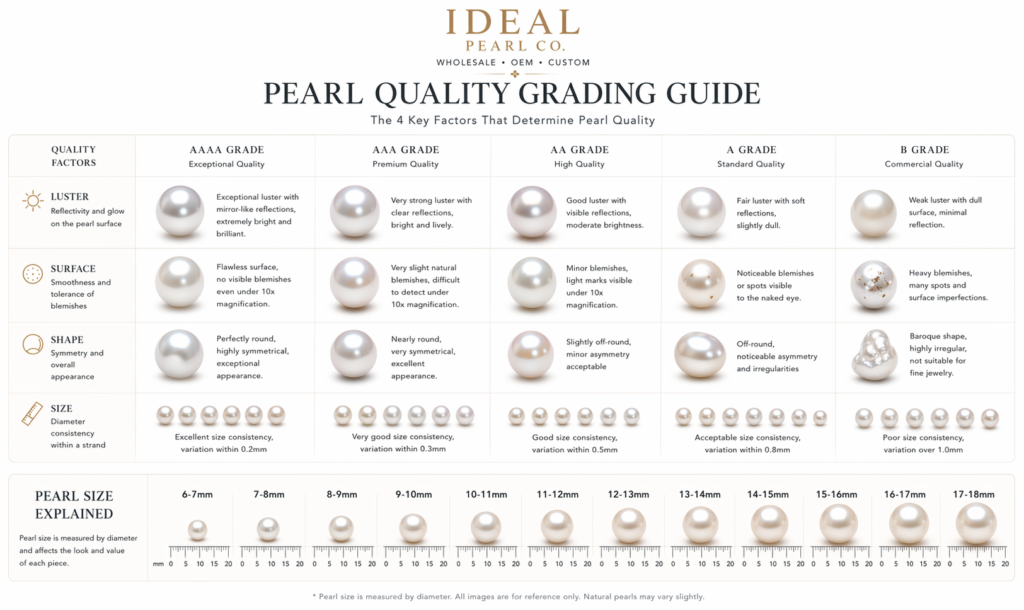
To evaluate pearl quality, buyers and brands need to understand five key factors: luster, surface cleanliness, shape, size, and nacre thickness. Understanding how each factor contributes to a pearl’s overall value helps brands, retailers, and wholesale buyers make more informed decisions when selecting pearls for jewelry collections, private label development, or market positioning.
Luster
Luster is the most visually defining quality factor according to GIA in a pearl. It refers to the brilliance and depth of light reflected from the pearl’s surface and from within the nacre layers beneath it.
Luster grades range from excellent to poor:
- Excellent — Sharp, bright reflections with strong contrast and depth
- Very Good — Bright reflections with minor diffusion
- Good — Reflections are visible but slightly diffused
- Fair — Weak and diffused reflections
- Poor — Dull surface with little to no reflection
High luster is the single most important quality indicator in pearl grading. A pearl with excellent luster will appear visibly more valuable and refined, regardless of size or shape. For retail and wholesale collections, luster should always be the primary quality consideration.
Surface Quality
Surface quality refers to the cleanliness and smoothness of the pearl’s outer nacre layer. Natural pearls and cultured pearls will almost always carry some degree of surface characteristic, as they are organic materials formed in a biological process.
Surface grades are typically assessed as:
- Clean — No visible blemishes under normal lighting
- Lightly Blemished — Minor surface marks visible on close inspection
- Moderately Blemished — Visible marks but concentrated in small areas
- Heavily Blemished — Prominent marks affecting the overall appearance
For jewelry collections, lightly blemished pearls are considered commercially acceptable and are widely used across mid-range and premium lines. Heavily blemished pearls are typically used in baroque or casual designs where surface variation is part of the aesthetic.
Shape
Pearl shape is graded from perfectly round to highly irregular. Shape affects both the aesthetic application and the price of the pearl.
Common shape categories:
- Round — Perfectly spherical, the most valued shape for classic jewelry
- Near Round — Slightly off-round, suitable for most strand and pendant applications
- Oval — Symmetrical elongated shape, used in drops and pendants
- Button — Flat on one side, commonly used in earrings
- Drop — Pear-shaped, ideal for earrings and pendants
- Baroque — Irregular and freeform, used in contemporary and artistic designs
- Keshi — Flat and irregular, formed without a nucleus, valued for high luster
Round pearls command the highest price premium due to the difficulty of producing perfectly spherical nacre growth. Baroque and keshi shapes, while irregular, are increasingly popular in modern jewelry design and offer strong value at accessible price points.
Nacre Thickness
Nacre thickness refers to the depth of the pearl coating that has formed around the nucleus during cultivation. Thicker nacre generally indicates a longer cultivation period and contributes to better luster, durability, and long-term value.
Nacre thickness guidelines:
- Akoya pearls — Minimum acceptable nacre is 0.35mm, with premium quality at 0.5mm and above
- Freshwater pearls — Often solid nacre with no nucleus, making nacre thickness less of a concern
- South Sea and Tahitian pearls — Nacre is typically very thick due to the longer cultivation period
Thin nacre can result in a pearl that chips, peels, or loses its luster over time. For collections intended for retail or wholesale, nacre thickness is an important quality checkpoint, particularly for Akoya pearls.
Color and Overtone
Pearl color is assessed in two layers: the body color and the overtone.
- Body color — The primary color of the pearl (white, cream, pink, gold, black, etc.)
- Overtone — A secondary color that appears to float on the surface (rose, green, silver, peacock, etc.)
The most commercially valued color combinations vary by market. In Australia and Europe, white pearls with rose overtones are consistently preferred for classic and bridal applications. Golden South Sea pearls perform strongly in Southeast Asian markets. Tahitian pearls with peacock overtones are widely sought after in contemporary fine jewelry collections globally.
Pearl Quality Summary Table
| Factor | What to Look For |
|---|---|
| Luster | Bright, sharp reflections — the higher the better |
| Surface | Clean to lightly blemished for retail collections |
| Shape | Round for classic, baroque for contemporary |
| Nacre | Thick nacre for durability and long-term luster |
| Color | Body color and overtone suited to target market |
Applying Quality Standards to Collection Development
When developing a pearl jewelry collection, quality standards should be aligned with your target price point and market positioning. A boutique fine jewelry line will require higher luster grades and cleaner surfaces than an everyday fashion collection. Establishing clear quality criteria before sourcing ensures consistency across your product range and reduces the risk of quality variation in bulk orders.
Explore More Pearl Guides
Looking to learn more? Browse our related guides:
- Pearl Size Guide: How to Choose the Right Pearl Size from 2mm to 15mm
- Freshwater vs Akoya vs South Sea vs Tahitian Pearls: A Complete Comparison Guide
- How Custom Pearl Jewelry Works: From Idea to Production
Ready to Build Your Collection?
Tell us your collection direction, target market, and customization needs — we’ll help you turn your ideas into a clear, market-ready pearl jewelry line.